What is a bay horse?
A reddish-brown body with black mane, tail, lower legs and ear rims. The black is the interesting part.
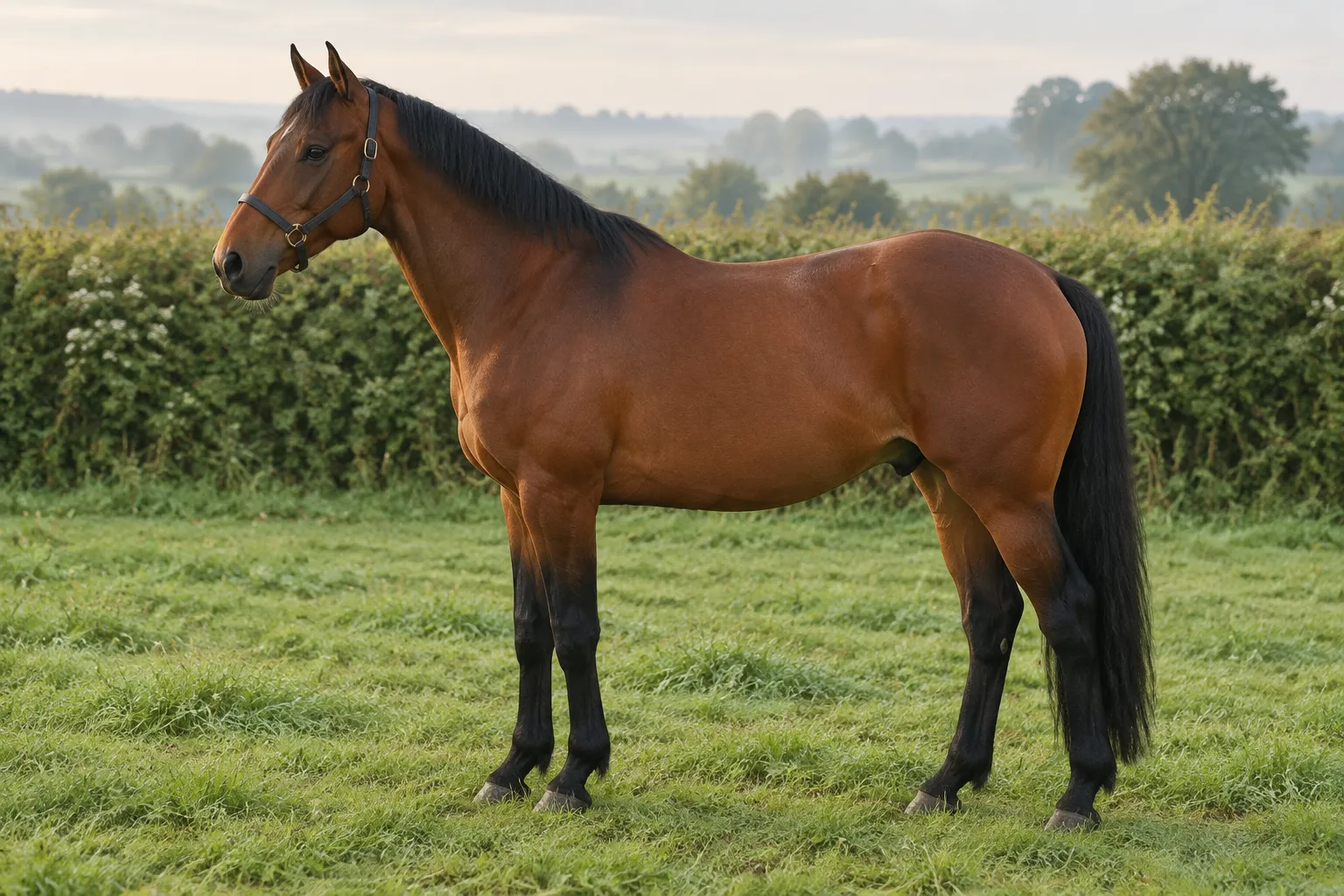
A bay horse has a reddish-brown or brown body with black mane, tail, lower legs and ear rims. Every description of the colour says that much, and it’s correct. What it leaves out is that the black is doing the work.
Where bay comes from
Base coat colour in horses comes from two genes. UC Davis’s Veterinary Genetics Laboratory describes them as Melanocortin 1 Receptor, the red factor locus, which “controls the production of red and black pigment”, and Agouti Signaling Protein, which “controls the distribution of black pigment”. Production and distribution are separate questions, and bay is an answer to the second one.
The VGL puts the mechanism in one sentence: the dominant Agouti allele “restricts black pigment to the points of the horse (mane, tail, lower legs, ear rims), while the recessive form (a) distributes black pigment uniformly over the body”. So a bay isn’t a brown horse with black bits added. It’s a horse making black pigment that Agouti has pushed out to the edges. Take that restriction away, and the same horse is black all over.
Why bay and black are one allele apart
That relationship explains something owners find surprising. Bay and black sit one allele apart, so a bay mare can carry black without showing it, and two bays can produce a foal that is neither. The VGL works the case through: breeding two bay horses heterozygous for both genes gives a 56.25% chance of a bay foal, 25% chestnut and 18.75% black. Two bay parents, and fewer than three foals in five come out bay.
One further point, and this is our reading rather than a sentence of theirs. The VGL summary table gives the wild-type allele as A for Agouti and E for Red Factor, and it calls the alternative red-factor alleles “loss of function mutations in MC1R”. Put those together and the wild-type horse, the one carrying neither loss, is a bay. On that reading bay isn’t one colour among many. It’s the one the others depart from, which is a fair part of why it turns up across so many breeds at once.
What the eye cannot settle
Appearance doesn’t settle everything. The VGL notes flatly that “it is not possible to know by appearance alone if a chestnut horse is able to produce a black horse”, which is what the Agouti test is for. A portrait is made from your own photograph, and the breed guides cover where bay is the rule and where it isn’t. Dilutions are a separate matter again: see dun or buckskin.