Horse height converter
Hands to centimetres, centimetres to hands, and feet either way. Type it however you say it out loud.
A bare number with no unit is read by size: 60 or more is taken as centimetres, 25 to 59 as inches, and anything smaller as hands.
Every figure here is arithmetic: one hand is four inches, one inch is 2.54 cm exactly. The hand is defined as four inches by the Scottish Government’s own conversion table; the pony height limit is the FEI’s, quoted below; the British measuring rules are the Joint Measurement Board’s.
Pony or horse
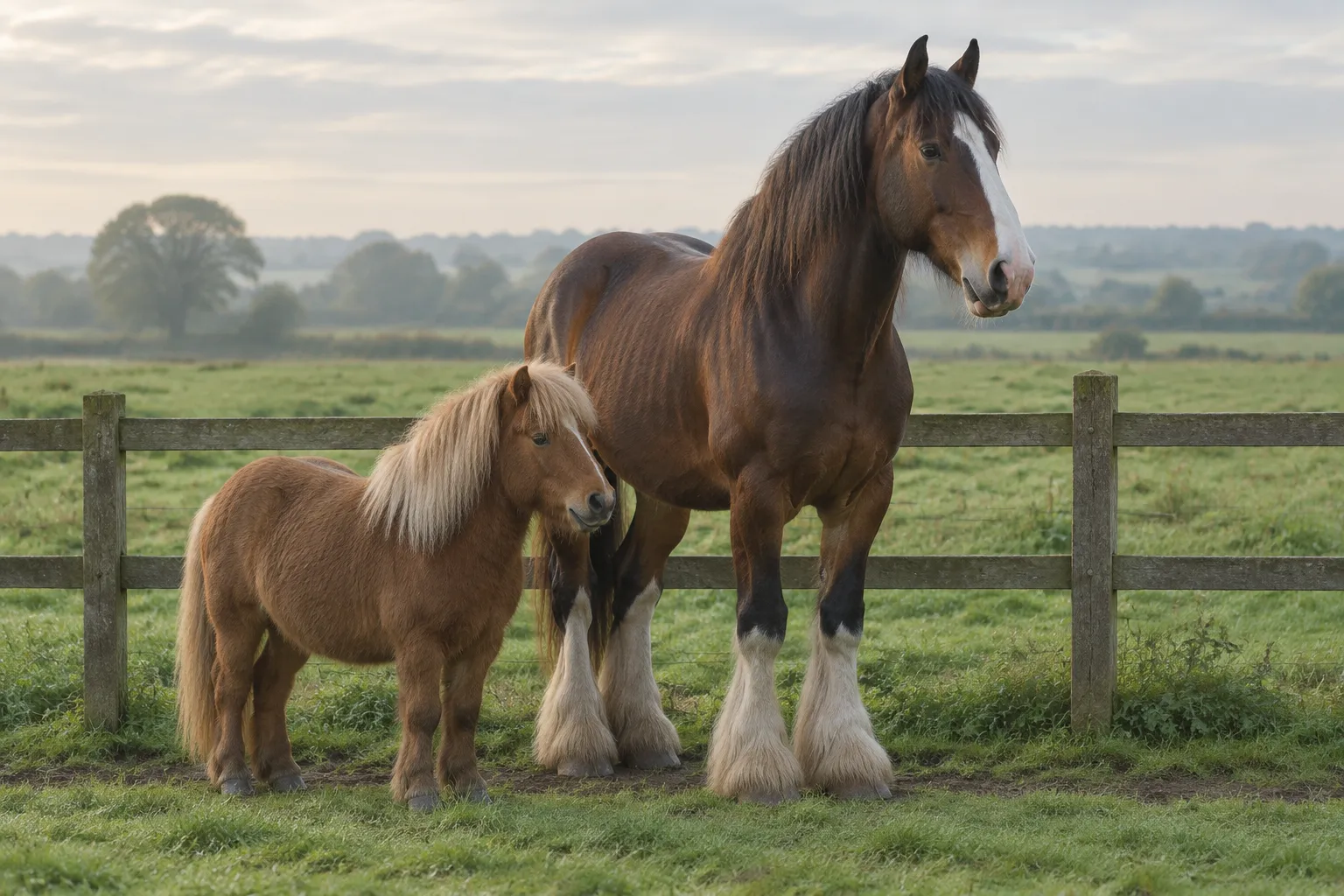
The line is written in centimetres, not hands: a pony’s height at the withers must not exceed 148cm without shoes. That is 14 hands and 2.27 inches, so it sits a little above the 14.2hh most people quote — 14.2hh is 58 inches, or 147.32cm. A horse measuring exactly 14.2hh is a pony under this rule.
“Ponies' regulatory height at the withers must not exceed: 148cm without shoes (any measurement between 148.1cm and 148.9cm will be rounded down to 148.0cm); and 149cm with shoes.” — FEI Veterinary Regulations 2026, Chapter IX, Article 1080.2
Why 15.2hh is not fifteen point two
A hand is four inches. The digit after the point is not a decimal fraction of a hand, it is a count of leftover inches, so it only ever runs .0, .1, .2, .3 and then rolls over to the next whole hand. There's no such height as 15.4hh, and 15.2hh means fifteen hands and two inches: 62 inches, or 157.5cm.
This is why converting in your head goes wrong. Fifteen point two hands would be 154.4cm if the fraction were a decimal. It is not, and the true answer is three centimetres taller.
How a horse is measured, officially
At the withers, the ridge between the shoulder blades, with the horse standing square on a level surface. Not at the head, which moves, and not at the highest point of the back. Most explanations stop there. The rules that govern a British show height are considerably tighter, and they are worth knowing even if you are only measuring at home with a stick against a wall.
In Britain, official heights are issued by the Joint Measurement Board. Its rules, effective from 1 January 2026, pin down the point on the horse anatomically: the measurement “must be taken at the highest point of the withers, (i.e. immediately above the spinous process of the 5th thoracic vertebra)”, which the measurer may identify by palpation and mark before measuring.
Four things then decide the number you get.
- The shoes come off. The horse
must have had all four shoes removed and the feet must be correctly prepared and balanced as for shoeing with the wall taken down level with the bearing edge of the sole
. - The head is held within a window. It must be in its natural position,
positioned so that the eye is neither more than 8 cm (3 in) below, nor more than 8 cm (3 in) above the highest point of the withers
. Raise the head and you lower the withers, which is precisely why the rule exists. - The horse stands square. All four feet taking weight, front legs parallel and perpendicular, the front toes in line to within 1.5cm, and the hind toes no more than 15cm out of line with each other.
- The lowest figure is the one recorded. The result submitted
must be the lowest truly relaxed height of the horse or pony in the opinion of the Official Measurer
, once it has settled and relaxed on the pad.
The stick matters too: it must carry a spirit level, be shod with metal, and have been certified by a Trading Standards Officer within the previous four calendar years. Horses cannot be measured at all before they are four years old, and a result differing from a previous one by 2cm or more can trigger a recall.
One current point that catches people out: since the 2026 rules, a paper certificate is no longer proof of anything. The JMB states that measurement certificates are no longer valid proof of any Measurement, the JMB’s Register represents the sole valid proof
.
So a horse can measure differently on two different days, and the official answer is deliberately the lowest honest one rather than the tallest. The FEI adds its own rounding rule and a separate allowance for shoes, quoted above.
The breed groups are set out in how horse breeds are grouped, and the cost of keeping one in what a horse costs.
Buying for someone else
If you are here because you are shopping rather than measuring, you do not need to know the horse’s height at all. See gifts for horse lovers, which assumes no horse of your own.
Pony, or a small horse
Height is the line, not age and not breed. A fully grown Welsh pony stays under it for life, while some horse breeds only cross it as adults, and a yearling measuring 13hh today is not a pony because of it. For the words used about sex and age rather than size, see what a gelding is.
Hands, and why Britain still uses them
The hand comes from exactly what it sounds like, the breadth of a human palm, standardised at four inches. Most of the world measures horses in centimetres and the rulebooks are written that way, but British and Irish yards still speak in hands, and both appear on the same passport. That is the whole reason this page exists.
Every height, hands to centimetres
| Hands | Inches | Centimetres | Feet & inches |
|---|---|---|---|
| 9.0hh | 36" | 91.4cm | 3' 0" |
| 9.1hh | 37" | 94.0cm | 3' 1" |
| 9.2hh | 38" | 96.5cm | 3' 2" |
| 9.3hh | 39" | 99.1cm | 3' 3" |
| 10.0hh | 40" | 101.6cm | 3' 4" |
| 10.1hh | 41" | 104.1cm | 3' 5" |
| 10.2hh | 42" | 106.7cm | 3' 6" |
| 10.3hh | 43" | 109.2cm | 3' 7" |
| 11.0hh | 44" | 111.8cm | 3' 8" |
| 11.1hh | 45" | 114.3cm | 3' 9" |
| 11.2hh | 46" | 116.8cm | 3' 10" |
| 11.3hh | 47" | 119.4cm | 3' 11" |
| 12.0hh | 48" | 121.9cm | 4' 0" |
| 12.1hh | 49" | 124.5cm | 4' 1" |
| 12.2hh | 50" | 127.0cm | 4' 2" |
| 12.3hh | 51" | 129.5cm | 4' 3" |
| 13.0hh | 52" | 132.1cm | 4' 4" |
| 13.1hh | 53" | 134.6cm | 4' 5" |
| 13.2hh | 54" | 137.2cm | 4' 6" |
| 13.3hh | 55" | 139.7cm | 4' 7" |
| 14.0hh | 56" | 142.2cm | 4' 8" |
| 14.1hh | 57" | 144.8cm | 4' 9" |
| 14.2hh | 58" | 147.3cm | 4' 10" |
| 14.3hh | 59" | 149.9cm | 4' 11" |
| 15.0hh | 60" | 152.4cm | 5' 0" |
| 15.1hh | 61" | 154.9cm | 5' 1" |
| 15.2hh | 62" | 157.5cm | 5' 2" |
| 15.3hh | 63" | 160.0cm | 5' 3" |
| 16.0hh | 64" | 162.6cm | 5' 4" |
| 16.1hh | 65" | 165.1cm | 5' 5" |
| 16.2hh | 66" | 167.6cm | 5' 6" |
| 16.3hh | 67" | 170.2cm | 5' 7" |
| 17.0hh | 68" | 172.7cm | 5' 8" |
| 17.1hh | 69" | 175.3cm | 5' 9" |
| 17.2hh | 70" | 177.8cm | 5' 10" |
| 17.3hh | 71" | 180.3cm | 5' 11" |
| 18.0hh | 72" | 182.9cm | 6' 0" |
| 18.1hh | 73" | 185.4cm | 6' 1" |
| 18.2hh | 74" | 188.0cm | 6' 2" |
| 18.3hh | 75" | 190.5cm | 6' 3" |
| 19.0hh | 76" | 193.0cm | 6' 4" |
| 19.1hh | 77" | 195.6cm | 6' 5" |
| 19.2hh | 78" | 198.1cm | 6' 6" |
| 19.3hh | 79" | 200.7cm | 6' 7" |
Written by Craig Fearn, Stable & Hoof. Last updated .
Questions, answered
How tall is a 15.2hh horse in cm?
How many cm is one hand?
What height is a pony rather than a horse?
How do you measure a horse in hands?
Do you measure a horse with its shoes on?
Why does the same horse measure differently on different days?
Why does the number after the point never go past 3?
Next — Choosing your horse
What is a Thoroughbred? →
A Thoroughbred is a horse breed developed for racing, prized above all for its speed and athleticism.
Also in dreaming of horses