The horse rug guide.
When a horse needs a rug, what the weights mean, and why two reputable sources will give you different answers for the same horse on the same day.
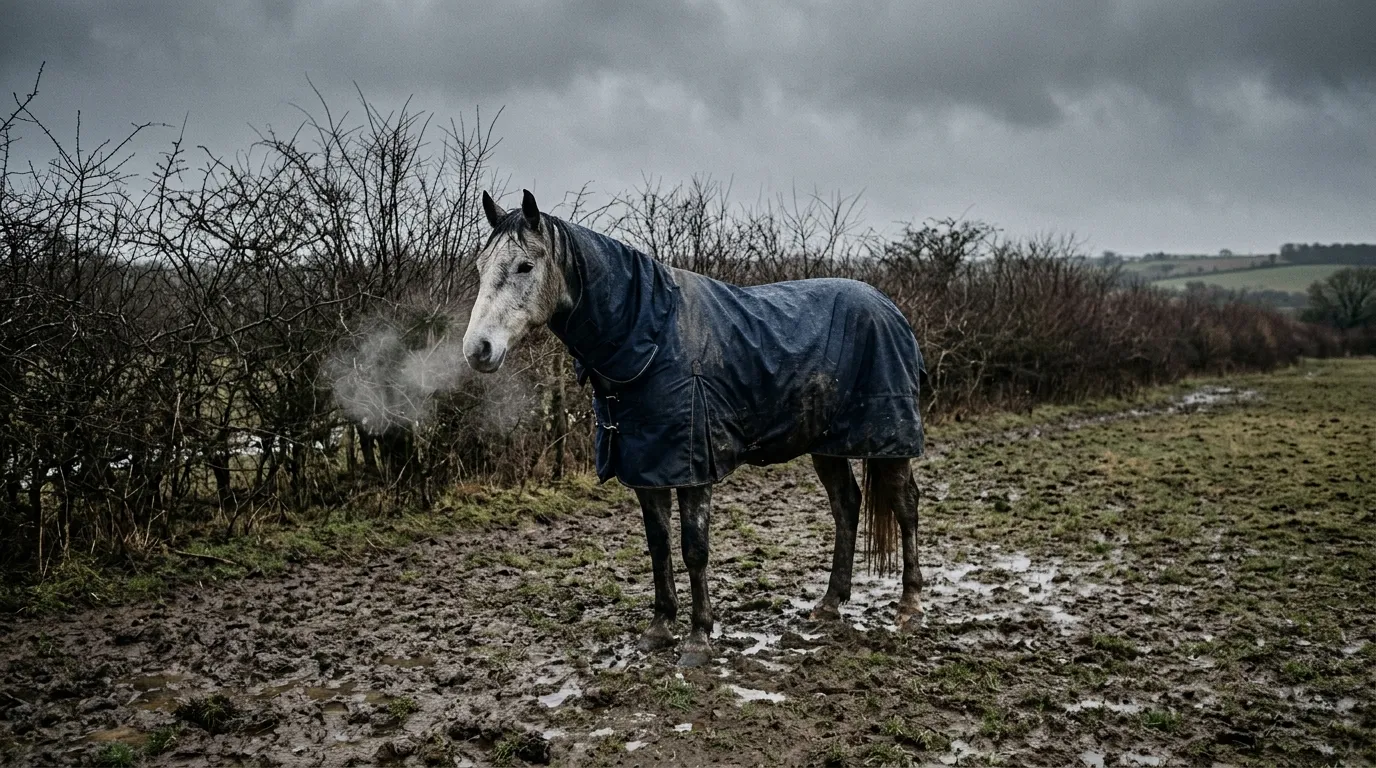
Rugging is the decision British owners make most often and agree on least. This guide covers when a horse needs a rug, what the weights mean, and why two reputable sources will give you different answers for the same horse on the same day.
The published scales do not agree
Start here, because it undermines every chart you'll read. The British Horse Society bands rug fills as “Light weight: 0g-100g”, “Medium weight: 150g-300g” and “Heavy weight: 350g+”.
The retailer currently ranking first in Britain for rug guidance bands the same product as coolers and sheets at 0g, lightweight at 50-150g, mediumweight at 151-250g and heavyweight at over 250g.
Put those side by side and a 300g rug is “medium” to the national welfare body and “heavyweight” to the shop selling it. A 120g rug is lightweight on one scale and falls in the gap between bands on the other. This is not a small discrepancy: it is a whole category, on the single number most people use to choose.
The practical consequence is that a rug’s stated weight in grams is the only figure worth comparing. Ignore the words light, medium and heavy entirely. They mean different things depending on who printed the label.
When a horse needs one
The BHS threshold is plainer than most: “Many horses stay comfortable without a rug until temperatures drop below 5°c.” Below that, the horse has to burn energy producing its own heat, and that is the point at which a rug starts doing something useful rather than something decorative.
Above it, a healthy unclipped horse in reasonable condition is usually better off without one. A horse’s winter coat works by trapping air in raised hair; a rug flattens it, and the BHS is direct about what that costs. The coat becomes “less efficient at trapping heat to insulate your horse’s body”.
What clipping changes
Clipping is the reason the answer differs between two horses standing in the same field. A horse clipped out has had the insulation removed deliberately, so it will need replacing. A horse with a bib or trace clip has kept most of it, and the BHS notes such horses “will often cope fine without a rug”.
So the honest order of questions is: is it below 5°C, is the horse clipped, is it wet or windy, and is the horse old, thin or unwell? Only the last three change the answer much.
Over-rugging is the commoner mistake
Under-rugging is visible, because a shivering horse is obvious. Over-rugging is not, and the BHS lists what it costs. A rug that is too warm can “trap heat and make it harder for your horse to cool down”, causing sweating and stress. Hidden sweating then “reduces the insulating properties of your horse’s coat and the rug”, so the rug makes the horse colder rather than warmer. Rugs also block sunlight, which “limits the production of vitamin D”. And the one with teeth: overfeeding alongside over-rugging “may increase the risk of excess weight gain and laminitis”.
A horse that cannot lose weight over winter is frequently a horse that was never allowed to be cold. Winter weight loss is a normal part of the year for a native pony, not a failure of care.
How to check, rather than guess
Feel behind the withers under the rug, not the ears and not the legs. Extremities run cool by design and tell you nothing. Warm and dry is right. Damp means the rug is too warm. Genuinely cold across the body, in a horse that is not otherwise unwell, means it is too light.
Do it at the coldest point of the day, which is usually shortly before dawn rather than when you arrive at the yard after work.
The breed changes the answer more than the calendar does
A Shetland and a Thoroughbred standing in the same field in the same weather need opposite things, and this is where generic charts fail hardest.
Native breeds, the Shetland, Welsh, New Forest, Highland, Connemara, and the cobs, evolved on British and Irish hills and grow a coat to match. Left unclipped they are frequently better unrugged well below the point at which an owner feels comfortable, and they are the type most at risk from the weight gain the BHS links to over-rugging. See the Shetland, Welsh and cob pages.
Thoroughbreds and lighter warmbloods are the other end. Thin-skinned, finer coated, often clipped for work through the winter, and less able to hold condition in cold wet weather. If any horse in the yard needs the heavier rug, it is usually this one. See the Thoroughbred.
Age and condition override breed. An old horse, a thin horse or one recovering from illness has less capacity to regulate whatever its ancestry, and that is a vet conversation rather than a rug one.
Fit, which matters more than weight
A correctly weighted rug that does not fit is worse than a lighter one that does. Rugs are sized in feet and inches in Britain, measured from the centre of the chest along the side of the body to the point of the buttock, not along the back, which is the commonest measuring error and gives a size too small.
Check for rubbing at the shoulder and withers. A rug that has slipped sideways has usually been fastened in the wrong order: chest first, then surcingles, then leg straps, and the reverse coming off.
Through the year
There is no date on which rugging starts. Autumn coats come in from roughly September and are usually full by November, so the horse is often better equipped in October than its owner assumes. The hardest months are not the coldest ones but the wettest and windiest, because a wet coat loses most of its insulating value. A still, dry night at minus two is easier on a horse than a wet, windy night at plus five.
Coming out of winter, take rugs off earlier rather than later. A horse that is allowed to feel spring arriving will shed properly, and the weight it lost over winter is the weight it is supposed to have lost.
Which rug is which
The types themselves, turnout and stable and cooler and fly, are covered in the short answer on what the types of horse rug are. This guide is about the decision rather than the wardrobe.
Written by Craig Fearn, Stable & Hoof. Last updated .
Questions, answered
At what temperature should you rug a horse?
What do light, medium and heavyweight mean on a horse rug?
Is it bad to over-rug a horse?
How do you tell if a horse is warm enough under a rug?
Do unclipped horses need rugs in winter?
Also in the daily round
Try it
Type a horse's name and watch the print set itself. Free, no photo needed.